Why do familiar streets become more revealing after the rain?
Rain does not merely darken a city. It rearranges attention, quiets the pavement and lets ordinary surfaces return the light they usually absorb.
01
A second surface
Wet stone creates a temporary city beneath the first one. Windows, lamps and fragments of sky appear underfoot, not as exact copies but as unstable impressions that change with every step. The pavement becomes a second, fragile field of observation, holding details that dry streets usually refuse to return.
The effect is modest and therefore easy to miss. A familiar street has not become another place; it has simply acquired enough uncertainty to be looked at again. Rain interrupts habit without erasing recognition, allowing the ordinary to feel newly composed rather than theatrically transformed.
02
Weather and distance
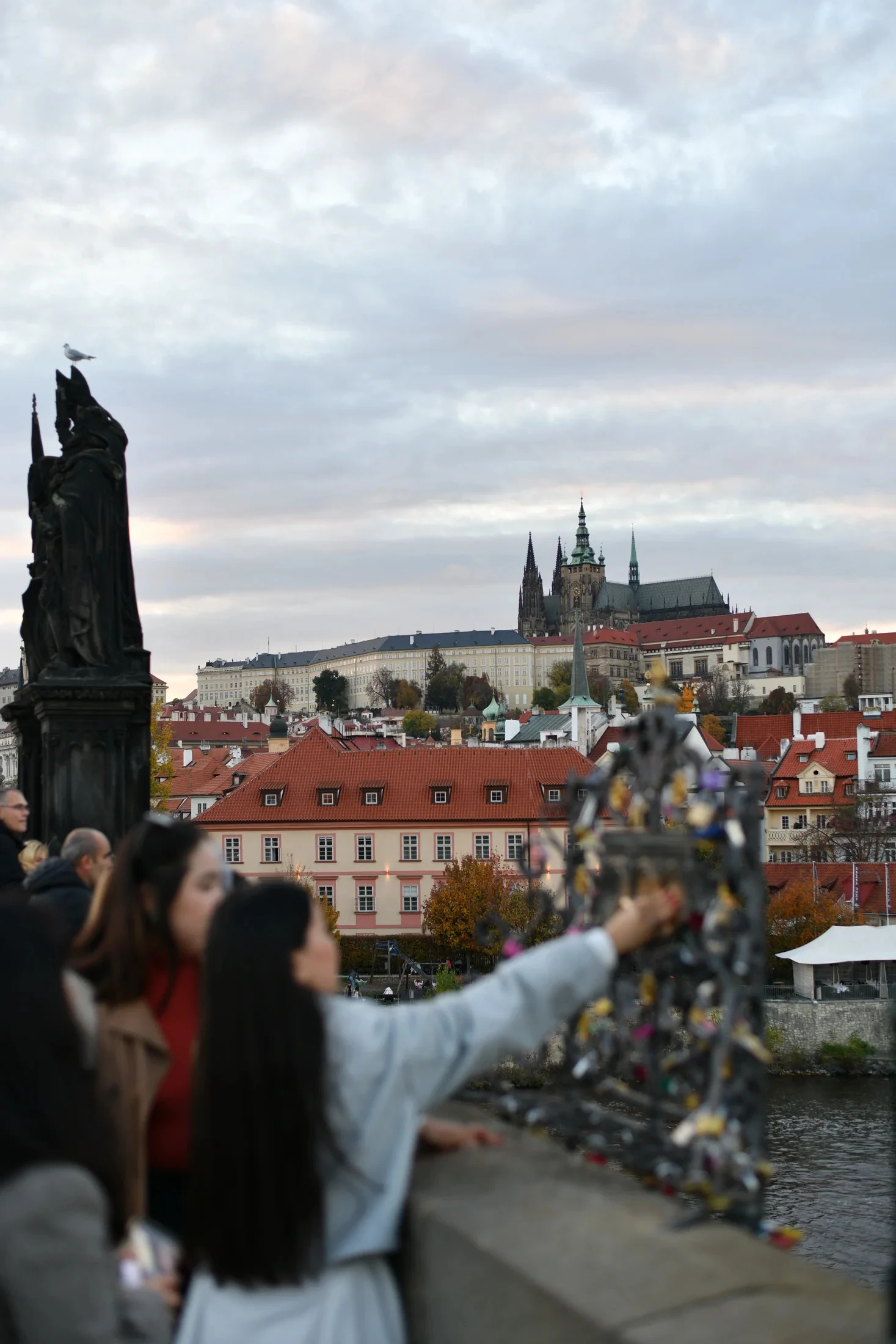
In Prague, rain gathers around cobbles and the river. In Vienna, it softens the authority of long facades. In Brussels, ornament and tram lines break into small moving reflections. Each city receives the same weather differently, revealing the materials, proportions and rhythms that daylight can make too familiar.
These cities are connected here neither by climate nor by itinerary. They belong together because rain briefly changes the distance between observer and architecture. Surfaces seem nearer, horizons less certain, and the traveller becomes more attentive to thresholds, gutters, windows and the quiet geometry of shelter.
03
The return of sound
After a shower, streets often feel quieter even when they are not. Tyres, footsteps and water from roofs become distinct, and the city can be experienced as a sequence rather than a single visual field. Sound separates into small events, giving movement a pace that the eye alone rarely notices.
That is the invitation of this perspective: not to seek dramatic weather, but to notice how a passing condition gives ordinary places another voice. The rain eventually leaves, yet the attention it awakened can remain, changing how the same street is seen long after the stone has dried.
A deeper reading
Three ways to remain with the idea
Reflection
What does rain reveal in a street that dry weather allows you to overlook?
Notice the altered sounds and temporary reflections before deciding what the weather has changed.
Photography note
- Observation
- The pavement held fragments of facades and sky, but every passing step interrupted the reflection before it could become decorative.
- Moment
- The frame belongs to the interval after the shower, when umbrellas were closing and the street had not yet returned to habit.
- Why this frame
- It was selected because the image keeps the ordinary street recognisable while showing how weather briefly gives it a second surface.
Journey meaning
Two Capitals
Moving between two cities makes the same weather readable through different materials, street proportions and habits of shelter, turning rain into a comparative way of observing architecture rather than a disruption to the journey.
Experience the idea through this route →Editorial path · 2 of 2
Weather, light and the altered city
Completion
This editorial line is complete
Light and rain have offered two ways of noticing the same proposition: a city becomes newly legible when ordinary conditions briefly loosen their hold.
Return to the Europe After Rain perspective →