Vienna · Austria
Austrian Parliament
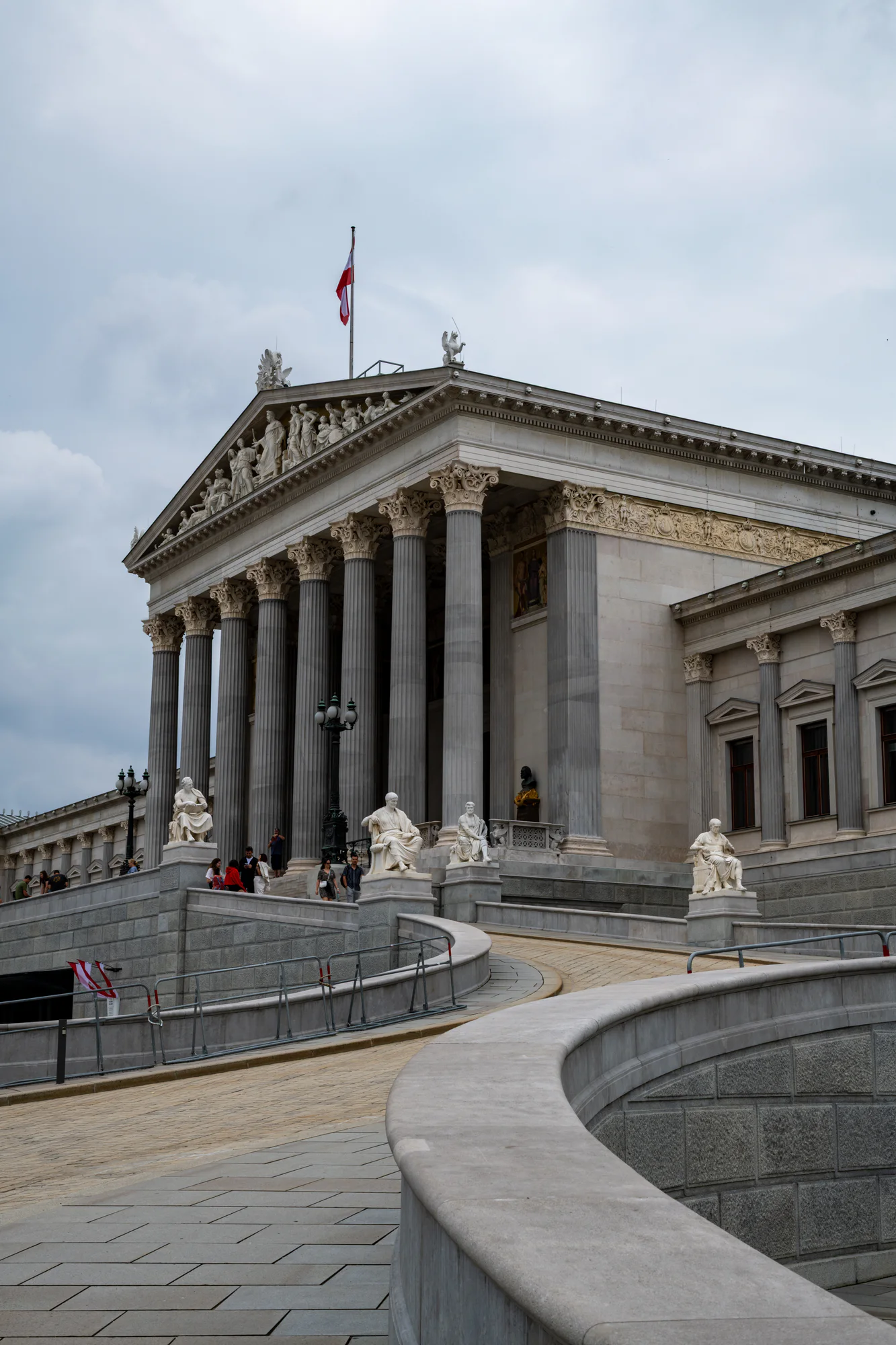
The Austrian Parliament gives the Ringstrasse a deliberately classical face. Columns, a broad symmetrical composition and sculptural groups connect a functioning parliamentary building with an architectural language drawn from ancient Greece, creating a sharp contrast with the nearby Neo-Gothic City Hall.
© Serhii Danyliuk / Europe In Frame ·Read the photograph’s story ↗
Vienna
About the place
16.3585° E
Theophil Hansen received the commission in 1869, and the foundation stone was laid in 1874. Parliament’s official architectural history explains that the Greek forms were chosen to recall the origins of democracy. Hansen’s work extended beyond the exterior to the interior and its furnishings, treating the building as a coordinated architectural whole.
The building has also had to adapt to changing institutions and practical requirements. Its recent renovation retained the historic fabric while creating contemporary infrastructure and visitor spaces. An exterior view therefore belongs to an active place of democratic work, not merely to a preserved nineteenth-century streetscape.
The front is useful for studying scale and repetition. Compare the rhythm of the colonnade with the smaller figures and details around it, and allow enough distance in the composition to show how the building occupies the boulevard. The neighbouring Rathaus demonstrates how two public institutions can express different civic ideas through different historical styles.
Vienna
Location
Dr.-Karl-Renner-Ring 3, 1017 Vienna
Open the Vienna map ↗Vienna · places and perspectives
Vienna on the map
Explore Vienna’s photographed places, from the historic centre and Schönbrunn to Setagayapark and Hauptbahnhof. Choose a place, then select one of its photographs or open the landmark guide. Markers identify places; an approximate location is labelled explicitly.

Drag with a mouse, use two fingers on a phone, or use the controls. With the map focused, use arrow keys, + / − and Home. Scrolling the page does not zoom the map.
Austrian Parliament
Austrian Parliament
The Austrian Parliament gives the Ringstrasse a deliberately classical face. Columns, a broad symmetrical composition and sculptural groups connect a functioning parliamentary building with an architectural language drawn from ancient Greece, creating a sharp contrast with the nearby Neo-Gothic City Hall.
- St Stephen’s Cathedral Through Vienna’s Streets ↗
- St Stephen’s Cathedral Roof and Stone Tracery ↗
- St Stephen’s Cathedral Stonework from Below ↗
- St Stephen’s Spire above the Street ↗
- Schönbrunn Palace from the Gloriette ↗
- Schönbrunn Palace across the Forecourt ↗
- Schönbrunn Palace and Vienna from the Hill ↗
- Schönbrunn through the Neptune Fountain ↗
- A Horse-Drawn Carriage in Schönbrunn Courtyard ↗
- Upper Belvedere and the Garden Cascade ↗
- Upper Belvedere beyond the Formal Garden ↗
- Upper Belvedere beside the Reflecting Pool ↗
- A Belvedere Sphinx beneath a Green Dome ↗
- A Belvedere Sphinx against the Palace Façade ↗
- Sphinxes along the Belvedere Terrace ↗
- A Belvedere Fountain Looking towards the City ↗
- Setagayapark Bridge beside the Waterfall ↗
- A Shaded Path through Setagayapark ↗
- Water and Flowers in Setagayapark ↗
Photographic archive
Austrian Parliament Columns and Curved Approach
Vienna
Before you visit
Consult Parliament’s official visitor pages for current guided tours, visitor-centre access, bookings and security requirements. A photograph of the exterior does not imply unrestricted access to the working building or its chambers.
Check the rules for bags, equipment and photography before an interior visit. From public space, keep entrances and crossings clear. The linked photographs offer an architectural record and a route back to the Vienna collection; they do not replace current visitor instructions from Parliament.
- parlament.gv.at
Austrian Parliament ↗
Photography locations